
This is my first year as a peer tutor at the Writing Center and I already feel that I’ve learned so much. Through the Writing Center training course, my observations of fellow tutors, and my own tutoring experiences, I’ve learned countless strategies and approaches to tutoring. One strategy that specifically stood out to me was a concept called scaffolding.
What is Scaffolding?
Scaffolding is a strategy tutors can use to help students develop skills by gradually letting them take the lead. I find this strategy to be really valuable for writers, as it can help them internalize skills during appointments so that they can feel confident in using these skills independently.
After learning about scaffolding, I wanted to learn more about how we can use scaffolding across various genres. I decided to specifically focus on how we can apply scaffolding to professional writing genres.
The Challenge:
Why may professional documents be difficult to tutor? Why do professional writing genres matter & what practices support tutoring professional writing?
Professional writing such as resumes and cover letters can be intimidating, especially for college-aged tutors and writers. These documents are real-world, high-stakes pieces of writing, so it was important to me to understand how to tutor professional writing in order to provide helpful and effective feedback to support writers with this often overwhelming writing task.
Additionally, I wanted to learn how to apply scaffolding as a strategy because professional documents are living, breathing documents that are constantly changing over time. Therefore, I knew scaffolding would be an effective approach as it can help writers build up writing skills so they can feel confident in writing and updating their professional writing on their own.
Key Insights
Genre Awareness
One of the key reasons why I chose to dive deeper into professional writing genres was because I’ve found that my peers, both tutors and writers, have various levels of familiarity with professional writing. This is why I decided to begin by looking into how to tutor unfamiliar genres.
In a study called “Negotiating Unfamiliar Genres: A Writing Center Study” by Rhonda K. Reid, I found that tutors can help writers understand unfamiliar genres through guided questioning, helping writers clarify the purpose, audience and structure of their writing. In professional writing, tutors can prompt writers to identify job-market audiences, then articulate their goals and adjust the tone and content of their writers for employers.
Scaffolding Practices
In a study on types of scaffolding by Mackiewicz and Thompson, I learned about three types of scaffolding that can be used in a sequence to help writers internalize skills.
- Instruction involves tutors explicitly providing information and suggestions.
- Ex: Explaining the application of action verbs to resumes
- Cognitive Scaffolding involves helping writers think, mainly through guiding questions.
- Ex: Asking, “Instead of what you did, can you think about what you accomplished?”
- Motivational Scaffolding involves motivating writers to go on their own.
- Ex: Providing praise & encouragement while inviting them to try on their own
What should writing center tutors take away?
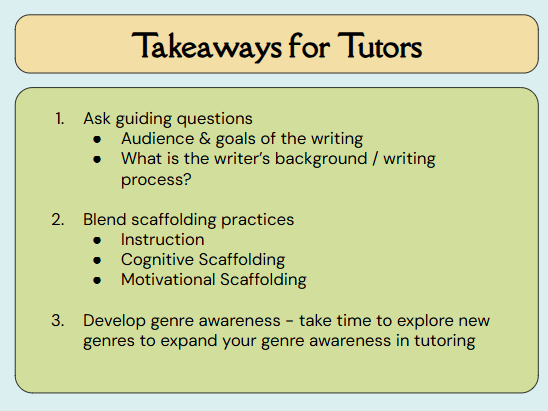
Based on what I’ve learned from reviewing these scholarly articles, these are the 3 main takeaways I have for tutors when it comes to tutoring professional genres through applying scaffolding.
References
Gorkemli, Serkan, and Tammy Conard-Salvo. “Professionalization, Tutor Training, and Service Learning in the Writing Center.” Praxis: A Writing Center Journal, vol. 4, no. 2, Spring 2007, pp. 1-8. The University of Texas at Austin.
Mackiewicz, Jo, and Isabelle Thompson. “Instruction, Cognitive Scaffolding, and Motivational Scaffolding in Writing Center Tutoring.” Composition Studies, vol. 42, no. 1, Spring 2014, pp. 54-78.
Nordlof, John. “Vygotsky, Scaffolding, and the Role of Theory in Writing Center Work.” The Writing Center Journal, vol. 34, no. 1, Fall/Winter 2014, pp. 45-64.Reid, Rhonda K. Negotiating Unfamiliar Genres: A Writing Center Study. 2021. PhD dissertation, The State University of New York at Buffalo.
Reid, Rhonda K. Negotiating Unfamiliar Genres: A Writing Center Study, State University of New York at Buffalo, United States — New York, 2021. ProQuest, https://www.proquest.com/dissertations-theses/negotiating-unfamiliar-genres-writing-center/docview/2578162960/se-2.
Discover more from UCWbLing
Subscribe to get the latest posts sent to your email.